
SOFTWARE
Three tools that help us buy smarter and respond faster.
IN-HOUSE TRAINED AI LEASING AGENT
AI Leasing Agent
Our own AI leasing agent, trained in-house on our apartments and policies. It answers renters and residents around the clock: available units, applications, pets and maintenance requests. It also hands people off to the right person on our team.
Chat with the AI Leasing Agent →IN-HOUSE TRAINED AI BUYING AGENT
AI Buying Agent
Our own AI buying agent, trained in-house on our acquisition criteria. It screens multifamily deals against our strategy, so our team spends its time on the buildings that fit and can move quickly when one does.
Try the AI Buying Agent →FOR THE PORTFOLIO
Building Data Platform
Our cloud backend and dashboard. It receives every sensor reading and camera photo, runs the detection models, and sends alerts to the right person on our team.
See the BDP →Try the AI Buying Agent
Open in a new window →HARDWARE
PILOTBuilding Hazard Warnings (BHW)
Real-time building hazard detection and warning
BHW is real-time building hazard detection and warning, the way a self-driving car watches the road. A self-driving car never stops reading its sensors, spots a hazard the moment it appears and reacts before anything goes wrong. BHW does the same for our buildings: its rules detect the hazards that come with every building, such as a boiler that stops firing, rising carbon monoxide, a flooding sump or an overflowing dumpster, in real time, and warn the right people right away. Each building gets a Boiler Node in the boiler room and a Camera Node at the dumpster. Each node has its own LTE-M cellular SIM and sends data straight to our Building Data Platform (BDP). They don't use the building's Wi-Fi, so they keep reporting even when a tenant's router is down. We're piloting them in our first 10 buildings.
BOILER ROOM MONITORING
Boiler Node
Boilers are among the most expensive equipment in a building, and replacing one often costs more than $100,000. The Boiler Node mounts on the boiler room wall near the sump pit and reports every 5 minutes. If carbon monoxide or the water level crosses a limit, it reports immediately.
| Sensor | What it measures |
|---|---|
| Sensor 1 | Boiler supply pipe temperature: is the boiler making heat |
| Sensor 2 | Carbon monoxide, in ppm |
| Sensor 3 | Sump pit water level: pump failing or falling behind |
| Sensor 4 | Room air temperature, humidity, air pressure and air quality |
- Catches a boiler that stops firing before residents lose heat
- Flags overheating and slow heat-up, an early sign of wear
- Warns of rising CO, sump flooding and a freezing boiler room
DUMPSTER MONITORING
Camera Node
A weatherproof camera on a wall or pole facing the trash area. It takes a photo whenever it detects motion, plus one every 15 minutes, and uploads each photo over cellular. It also checks in every hour, so we know it's still online. In the cloud, a vision model reviews every photo so we can fix problems before the city writes a ticket.
| Component | Role |
|---|---|
| Sensor 1 | Wide-angle camera: JPEG photos of the whole trash area |
| Housing | Outdoor waterproof enclosure for Chicago weather |
| Light | Motion-activated light for clear photos at night |
- Prevents sanitation citation tickets
- Catches overflowing dumpsters and sends the crew
- Spots rodent activity early
- Flags illegal dumping and bulk items, and smoke or fire
Inside every node
BUILDING DATA PLATFORM
PILOTEvery building, both nodes, one cloud brain.
The nodes only collect and send. All the analysis, including every camera photo, happens in our cloud. There, BHW rules, learning models and a vision model detect each building's hazards in real time and route every warning to the right person.
Building Data Format (BDF)
Every message to the BDP follows BDF: a small JSON document sent over MQTT or HTTPS. Every message starts with the same header: the building ID, the node ID and a UTC timestamp. A building's latitude and longitude never change, so the cloud stores them once in its building registry instead of sending them in every message. The building ID links each message to its location, which puts the building on the portfolio map and lets the cloud check outdoor weather at that address, such as how cold it is during a no-heat alarm. UTC timestamps keep every node on one clock, with no daylight-saving gaps, so both nodes line up on a single timeline. Messages are a few hundred bytes, so a node's cellular data use stays low.
Boiler Node reading · every 5 minutes, or immediately on a limit
{
  "building": "pilot-05",
  "node": "boiler-room-01",
  "ts": "2026-11-19T18:00:00Z",
  "type": "reading",
  "supply_pipe_f": 171.2,
  "air_f": 75.8,
  "humidity_pct": 46.1,
  "air_pressure_hpa": 1013.4,
  "air_quality_kohm": 58.2,
  "co_ppm": 1.6,
  "sump_cm": 18.2
}
| Field | Unit | Meaning |
|---|---|---|
building | ID | Building ID (all messages) |
node | ID | Which node sent it (all messages) |
ts | UTC, ISO 8601 | When the reading or photo was taken, in UTC, ending in Z (all messages) |
supply_pipe_f | °F | Boiler supply pipe temperature (Sensor 1) |
co_ppm | ppm | Carbon monoxide (Sensor 2) |
sump_cm | cm | Water depth in the sump pit (Sensor 3) |
air_f, humidity_pct | °F, % | Boiler room air temperature and humidity (Sensor 4) |
air_pressure_hpa, air_quality_kohm | hPa, kΩ | Air pressure and an air-quality reading (Sensor 4) |
Camera Node photo · on motion and every 15 minutes
{
  "building": "pilot-05",
  "node": "cam-dumpster-01",
  "ts": "2026-11-19T18:00:00Z",
  "type": "photo",
  "trigger": "motion",
  "image": "stenneth-cam/pilot-05/2026-11-19/1800Z.jpg"
}
trigger is motion or interval. The JPEG uploads separately and is stored by building and UTC date, and the message points to it.
Heartbeat · every hour, both nodes
{
  "building": "pilot-05",
  "node": "cam-dumpster-01",
  "ts": "2026-11-19T19:00:00Z",
  "type": "heartbeat",
  "signal_dbm": -97,
  "uptime_h": 312
}
If a heartbeat or reading doesn't arrive on time, the cloud raises a "node offline" alert.
Alert · created by the cloud and sent by the alert router
{
  "alert_id": "a-2026-11-19-0412",
  "building": "pilot-05",
  "hazard_detected": "No heat: boiler not firing",
  "detector": "boiler_no_heat",
  "engine": "rule",
  "severity": "critical",
  "ts": "2026-11-19T11:40:00Z",
  "message": "Supply pipe 104°F for 20 min, 18°F outside",
  "notify": ["maintenance", "vendor:ralphs-heating"],
  "work_order": true
}
Every alert has a hazard_detected slot that names the hazard in plain words, so the person who gets the text or call knows right away what's wrong. It also records which detector fired, whether it came from a rule, a learning model or the vision model, how serious it is, and who was notified.
Severity decides how people hear about it. A notice appears on the dashboard. A warning also texts the maintenance team. A critical alert also places a phone call, opens a work order and alerts the vendor.
When the reading returns to normal, the alert closes on its own. The dashboard keeps the full history.
Building Data Platform (BDP)
The BDP is where every building's data ends up. Each node sends its readings and photos over its own cellular connection to a secure ingest service. The cloud stores everything by building, runs the detection engine on every reading and photo, and decides who needs to know. Routine items go to the dashboard. Urgent ones reach our maintenance team, and the right outside vendor is alerted directly. For example, Ralph's Heating and Cooling gets the call when a boiler stops firing.
It runs in cloud accounts we own, so all the code and data are ours. It's built to grow from our 10-building pilot to 100 buildings with no change to the nodes.
How the data flows
- 1. NodesThe Boiler Node sends readings every 5 minutes, and right away when a limit is crossed. The Camera Node sends a photo on motion and every 15 minutes.
- 2. CellularData travels over LTE-M, encrypted with TLS, and each device has its own secure login.
- 3. Secure ingestAn MQTT/HTTPS endpoint in Stenneth-owned cloud accounts. Readings go to a time-series database and photos to object storage, filed by building.
- 4. DetectionBHW rules detect each building's hazards in real time against hard safety limits. Learning models figure out each building's normal pattern, and a vision model checks every photo.
- 5. Alerts & dashboardDepending on severity, the platform sends a text or an email, or places a call. It can also open a work order and logs everything to the dashboard.
Hazards BHW detects in real time
| Hazard | Engine | Data used | Who it alerts |
|---|---|---|---|
| Carbon monoxide | Rule | CO ppm | Emergency line and management, 911 when critical |
| Boiler failure / no heat | Rule | Supply pipe temperature | Heating contractor and maintenance |
| Boiler overheat | Rule | Supply pipe temperature | Heating contractor (emergency) |
| Sump high water / pump failure | Rule | Sump water level | Maintenance (emergency) |
| Freezing boiler room | Rule | Room air temperature | Maintenance |
| Humidity anomaly (hidden leak) | Learning model | Humidity vs. the building's learned normal | Maintenance inspection |
| Boiler wear (predictive) | Learning model | Heat-up rate per burner cycle | Heating contractor: schedule service |
| Dumpster overflow | Vision | Camera photo | Janitorial crew and hauler |
| Illegal dumping / bulk items | Vision | Camera photo | Janitorial crew and bulk pickup |
| Rodent activity | Vision | Camera photo | Pest control |
| Dumpster smoke / fire | Vision | Camera photo | 911 and management |
| Node offline | Rule | Missed readings or hourly check-in | Maintenance |
Backend
- MQTT or HTTPS over TLS, with a separate secure login per device
- Time-series database for readings, object storage for photos
- Runs in Stenneth-owned cloud accounts. Stenneth owns all code and data
- Built to grow from a 10-building pilot to 100 buildings
The dashboard
Everything the cloud stores and detects shows up on one dashboard for our management team and investors.
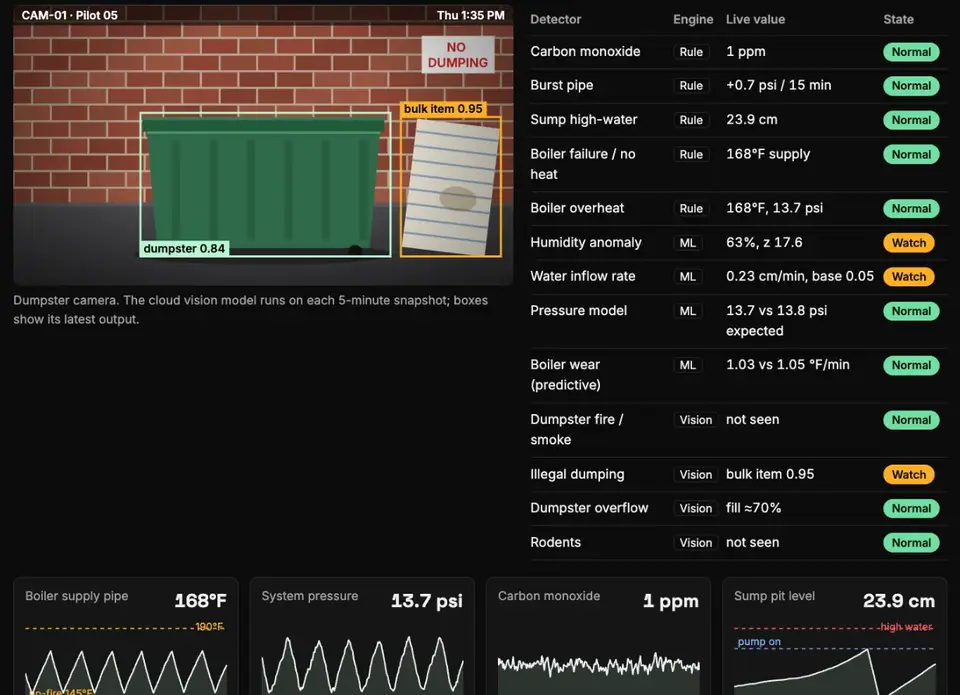
- Portfolio view: every building, both nodes online or offline, worst alert first
- Building console: latest camera photo with the vision model's boxes, plus every detector's live state
- Charts: boiler temperature, CO, sump level, humidity and air temperature over time
- Alert feed: every alert across all buildings, who it went to, and when it cleared
- Per-building limits, so each boiler and sump is judged against its own normal
WORK WITH US